Invoice Factoring
When cash is tied up in unpaid invoices, every week you wait on customer payment is a week you can't make payroll, restock inventory, or take on a new contract. Invoice factoring exists to close that gap. It converts outstanding receivables into immediate working capital, often without creating the same kind of debt obligation as a loan.
Understanding how does invoice factoring work starts with a simple premise: you sell unpaid invoices to a third party, called a factor, at a discount. The factor advances most of the invoice value upfront and collects payment directly from your customer. You get cash now. The factor earns a fee for handling collections and advancing cash while waiting for payment.
This guide explains invoice factoring explained from start to finish. You'll learn the mechanics, the costs, the different types available, and which industries benefit most. Whether you run a staffing agency waiting 60 days on every placement or a trucking company with fuel bills due Friday, the information here applies. Think of this page as your factoring 101 reference point, with links to deeper resources on every subtopic.
The guidance below reflects common real-world factoring scenarios.
How Invoice Factoring Works
The factoring process follows a consistent pattern across industries and providers. Once you understand the five-step cycle, you can evaluate any factoring offer with more confidence.
You deliver goods or services and issue an invoice to your customer with standard payment terms, often net 30, 60, or 90 days.
You submit the invoice to a factoring company. The factor reviews the invoice and evaluates your customer's creditworthiness, not yours. That differs from traditional lending.
The factor advances you 80-95% of the invoice value, sometimes within 24 to 48 hours. The exact advance rate depends on your industry, invoice size, and your customer's payment history.
Your customer pays the invoice according to the original terms. Payment goes directly to the factoring company.
The factor releases the remaining balance, minus their fee, often around 1-5% of the invoice value depending on the deal. This final payment is called the rebate or reserve release.
The cycle repeats with each batch of invoices you submit. Many businesses factor on a rolling basis, submitting new invoices weekly or even daily as they generate them.
What makes factoring distinct from a loan is that you're selling an asset, not borrowing against one. There's usually no fixed repayment schedule like a term loan, no interest compounding in the same sense, and the accounting treatment differs from debt financing. The transaction generally ends when your customer pays.
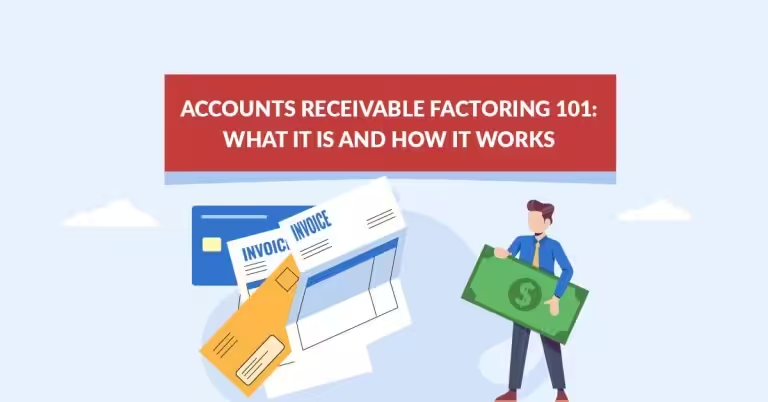
For a deeper breakdown of the mechanics, including how factoring companies evaluate your accounts and what documentation you'll need, read our guide on accounts receivable factoring 101.
Types of Invoice Factoring
Not all factoring arrangements work the same way. The type you choose affects your risk exposure, flexibility, and cost. Here are the main variations you'll encounter.
Recourse vs. Non-Recourse Factoring
In recourse factoring, you remain responsible if your customer doesn't pay. If the invoice goes unpaid past a certain period, you must buy it back or replace it with another invoice. Recourse factoring is more common and usually less expensive because the factor carries less risk.
In non-recourse factoring, the factor absorbs the loss if your customer fails to pay due to insolvency or bankruptcy. Because the factor takes on more risk, non-recourse agreements usually come with higher fees and stricter customer credit requirements. In practice, many “non-recourse” agreements apply only to specific nonpayment scenarios, so read the fine print on what triggers actually qualify.
Spot Factoring vs. Contract Factoring
Spot factoring (also called single-invoice factoring) lets you factor individual invoices as needed, with no long-term commitment. You choose which invoices to factor and when. This flexibility often comes at a higher per-invoice cost, but it works well for businesses with occasional cash flow gaps.
Contract factoring requires you to commit a minimum volume of invoices over a set period, often 6 to 12 months. In exchange, you may receive lower rates and more predictable terms. This structure suits businesses that factor regularly.
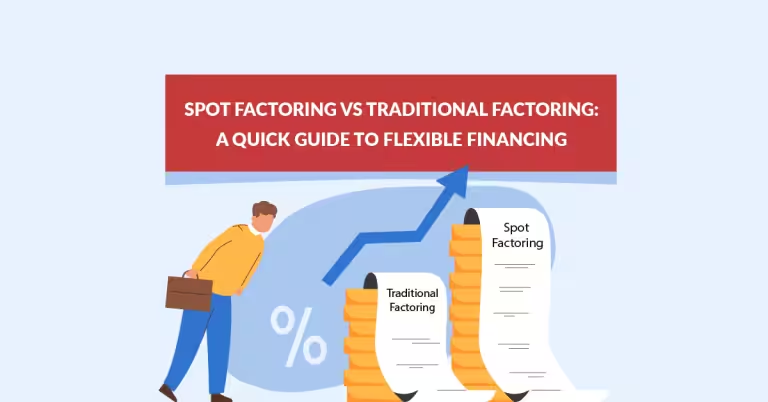
The choice between these models depends on how often you need funding and how predictable your cash flow gaps are. Our comparison of spot factoring vs. traditional factoring breaks down the trade-offs in detail.
Selective Invoice Factoring
Some providers offer selective factoring, which sits between spot and contract models. You commit to a relationship but retain the ability to choose which invoices to factor from a larger pool. This gives you more control than a full-ledger contract without paying spot-factoring premiums on every invoice.
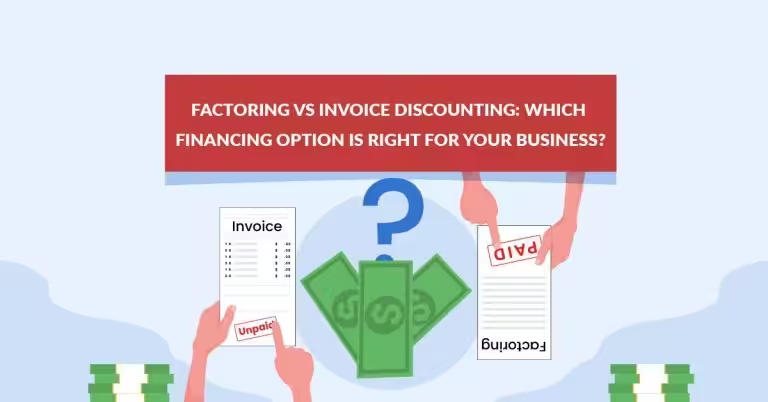
Understanding the structural differences between factoring and invoice discounting (where you retain collection responsibilities) matters too. Read our guide on factoring vs. invoice discounting to see which model fits your operations.
Factoring Costs and Fees
Invoice factoring fees often fall around 1% to 5% of the invoice value, though pricing varies by provider and deal structure. Understanding what drives the rate helps you compare offers and negotiate better terms.
What Determines Your Rate
Invoice size and volume. Larger invoices and higher monthly volumes generally mean lower per-invoice fees. Higher monthly volume often improves pricing.
Customer creditworthiness. Since the factor collects from your customers, their payment history and credit profile directly affect your rate. Invoices to large, established companies often cost less to factor than invoices to smaller, unrated businesses.
Payment terms and speed. Longer payment terms increase the factor's risk and carrying cost, which usually translates to higher fees. A net-90 invoice often costs more to factor than a net-30.
Industry. Some industries carry higher default rates or slower payment cycles. Construction, for example, can carry higher factoring fees than staffing due to lien complexities and longer project timelines.
Contract structure. Recourse agreements usually cost less than non-recourse. Long-term contracts often cost less per invoice than spot factoring.
Beyond the discount rate, watch for additional fees: application fees, due diligence fees, wire transfer fees, monthly minimums, and early termination penalties. A low headline rate with monthly minimums and a large termination fee isn't necessarily cheaper than a slightly higher rate with fewer extras.
To evaluate whether factoring makes financial sense for your situation, our checklist for evaluating AR financing options walks through the decision step by step.
Industries That Benefit Most from Invoice Factoring
Factoring works for any B2B business that invoices on terms, but certain industries benefit more than others because of their cash flow dynamics.
Construction
Construction companies often wait 60 to 120 days for payment while covering material costs, subcontractor bills, and payroll upfront. Progress billing, retention holdbacks, and change orders can make cash flow unpredictable. Factoring helps bridge the gap between project milestones and actual payment.
Staffing and Recruiting
Staffing agencies pay employees weekly but invoice clients on net-30 or net-60 terms. The mismatch between payroll obligations and client payments creates persistent cash flow pressure that grows with every new placement. Factoring is common in this industry for exactly this reason.
Trucking and Transportation
Carriers incur fuel, maintenance, and driver payment costs immediately but often wait 30 to 90 days for brokers and shippers to pay. Factoring is common enough in trucking that specialized freight factoring companies exist to serve this market.
Manufacturing
Manufacturers purchase raw materials, run production, and ship finished goods weeks or months before payment arrives. Large purchase orders can strain cash reserves even when profitability is strong. Factoring lets manufacturers take on bigger orders without worrying as much about cash timing.
Healthcare
Medical practices, staffing agencies, and device companies that bill insurance carriers or government programs often face slow reimbursement cycles. Factoring converts those receivables into immediate cash to cover operating expenses while claims work through the system.
For a detailed breakdown of which sectors see the most benefit, read the top five industries that benefit from AR factoring. If your business is seasonal, our guide on how factoring supports seasonal industries covers strategies for managing cyclical cash flow. And if you're a small business competing against larger, better-capitalized competitors, see how factoring helps small businesses compete.
Factoring vs. Other Financing Options
Factoring isn't the only way to access working capital. Choosing the right tool means understanding how factoring compares with the alternatives.
Factoring vs. Traditional Bank Loans
Bank loans often offer lower rates but require strong credit, collateral, and weeks or months of underwriting. They add debt to your balance sheet and come with fixed repayment schedules regardless of your revenue. Factoring approvals are often faster, based more heavily on your customers' credit than yours, and can scale with your sales volume.
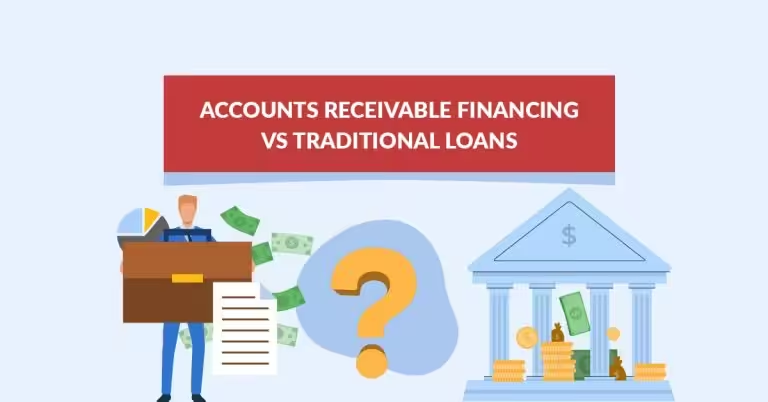
The trade-off: factoring usually costs more per dollar accessed than a traditional term loan. If you qualify for a bank loan and have time to wait for approval, it may be cheaper. If you need capital this week and your customers are creditworthy, factoring may be the faster path. Our detailed comparison of AR financing vs. traditional loans covers the full analysis.
Factoring vs. Lines of Credit
A business line of credit provides flexible access to funds you can draw and repay as needed. It functions more like a safety net than a one-time capital injection. However, lines of credit usually require good credit scores, established business history, and periodic renewals. Factoring often has lower qualification barriers and doesn't create the same kind of revolving debt obligation.
Factoring vs. Merchant Cash Advances
Merchant cash advances (MCAs) provide fast capital but can translate into very high effective annualized costs. Repayment is deducted daily from your revenue. Factoring is often less expensive and doesn't create the same cash flow drag as daily MCA deductions.
It's worth noting that invoice financing, a related but distinct product, lets you borrow against your receivables while retaining control of collections. Factoring involves selling the invoices outright. Both solve cash flow timing problems, but the mechanics and costs differ. For a broader look at why businesses are shifting toward receivables-based options, read why more businesses choose AR financing over traditional loans.
How to Prepare for Invoice Factoring
Getting started with factoring is faster than applying for a bank loan, but preparation still matters. Knowing what factors look for helps you present your business clearly and secure better terms.
What Factoring Companies Evaluate
Your customers' credit profiles. The factor is betting on your customers paying, not on you. Strong customer credit often means better rates and higher advance percentages.
Invoice quality. Invoices should be clean, accurate, and free of disputes. Outstanding liens, offsets, or unresolved delivery issues make invoices harder to factor.
Your accounts receivable aging. Factors generally prefer invoices that are current or recently issued. Many may exclude older receivables.
Industry and concentration risk. If a large share of your revenue comes from one customer, the factor faces concentration risk. Diversified customer bases often get better terms.
Common Mistakes to Avoid
Business owners sometimes undermine their factoring applications by submitting disputed invoices, failing to notify customers about the factoring arrangement, or not reviewing contract terms carefully enough. Early termination fees, minimum volume requirements, and notification clauses can all create problems if you don't address them upfront.
Our guide on how to prepare your business for AR financing covers the documentation checklist in detail. For the most common pitfalls and how to sidestep them, read avoiding pitfalls in AR factoring.
The Future of Invoice Factoring
Factoring has existed for centuries, but the pace of change has accelerated. Technology is driving much of that shift.
Digital platforms can reduce the time from application to first funding from weeks to days or, in some cases, hours. Automated credit analysis, electronic invoice verification, and API integrations with accounting software mean less paperwork and faster approvals. Some platforms now offer same-day advances on verified invoices.
Blockchain and smart contracts are beginning to appear in parts of supply chain finance, enabling automated payment triggers when delivery conditions are met. While still early, these technologies could reduce some disputes and lower verification costs over time.
The rise of embedded finance means factoring is increasingly available within the accounting and invoicing tools businesses already use. Instead of seeking out a separate factoring company, some businesses may soon access factoring with a single click inside their ERP or accounting platform.
For a deeper look at where the industry is heading, read the future of AR factoring: trends to watch and how invoice discounting is transforming cash flow management.
Additional Resources
This guide covers the essentials, but every business situation has nuances. The following resources go deeper on specific aspects of receivables-based funding:
What are receivables in finance? A foundational explainer on accounts receivable and their role in business operations.
Benefits of invoice financing for small businesses. How receivables-based funding supports growth at the small business level.
5 ways to use AR funding to fuel growth. Practical strategies for deploying factoring proceeds effectively.
How to fund growth through invoice financing. A growth-focused perspective on leveraging receivables.
Receivables financing overview. A broad look at the receivables funding landscape.
What is AR financing and how can it boost cash flow? Covers the cash flow acceleration angle in detail.
Top benefits of AR financing for SMEs. Tailored to small and medium-sized enterprises.
What is invoice financing and how does it work? Covers the broader invoice financing category.
How does invoice financing work? A mechanics-focused companion piece.
Invoice financing for small businesses. Audience-specific guidance for smaller operations.
Frequently Asked Questions
How does invoice factoring work?
You sell your unpaid B2B invoices to a factoring company at a discount. The factor advances you 80-95% of the invoice value, typically within 24-48 hours. When your customer pays the invoice on its original terms, the factor releases the remaining balance minus a fee of 1-5%. The key difference from a loan is that you're selling an asset rather than borrowing, so it usually does not work like a traditional debt obligation and there is no monthly repayment schedule in the way there is with a term loan.
What is the difference between factoring and invoice discounting?
In factoring, the factoring company takes over collections and communicates directly with your customers. In invoice discounting, you retain control of collections and your customers may never know a third party is involved. Discounting tends to be more common among larger businesses with established credit management processes, while factoring is often accessible to a wider range of companies. Both convert receivables into immediate cash, but the operational responsibilities differ significantly.
How much does invoice factoring cost?
Factoring fees typically range from 1% to 5% of the invoice value. The rate depends on your monthly volume, your customers' creditworthiness, the length of payment terms, your industry, and whether you choose recourse or non-recourse factoring. Beyond the discount rate, check for additional charges like wire fees, monthly minimums, due diligence fees, and early termination penalties. Always calculate the total cost of factoring, not just the headline rate.
Can startups use invoice factoring?
Yes. Because factoring companies evaluate your customers' credit rather than yours, startups with creditworthy B2B clients can sometimes qualify even without established business credit or years of operating history. This can make factoring one of the more accessible financing options for newer businesses. The main requirement is that you have legitimate, verifiable invoices to customers who have a track record of paying their bills.
Does factoring affect my customer relationships?
It can, but it doesn't have to. In notification factoring, your customers are informed that a third party will collect payment. Professional factoring companies typically handle this communication respectfully and routinely. Customer impact is often manageable when communication is handled well. If discretion is important to you, ask whether non-notification options are available or consider invoice discounting, where you retain the collection process entirely.
What happens if my customer doesn't pay?
The answer depends on your agreement type. In recourse factoring (the most common arrangement), you're responsible for buying back the unpaid invoice or replacing it with another one. In non-recourse factoring, the factor absorbs the loss if your customer fails to pay due to insolvency or bankruptcy. However, non-recourse protection typically doesn't cover disputes, short payments, or customers who simply refuse to pay for non-insolvency reasons. Read the contract carefully to understand exactly what scenarios are covered.
Turn Your Invoices Into Working Capital
If unpaid invoices are slowing your business down, factoring can put that capital to work sooner. Reil Capital connects business owners with factoring solutions matched to their industry, invoice volume, and cash flow needs.
Explore invoice financing at Reil Capital to see your options, or apply now to discuss what factoring could look like for your business.