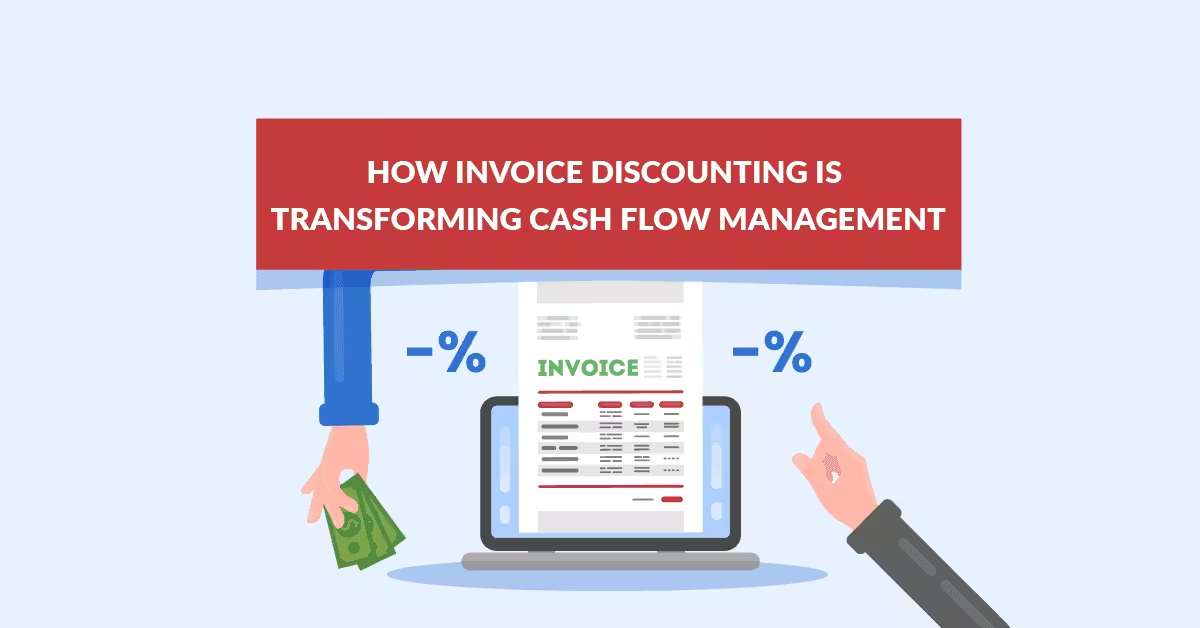
Invoice discounting closes the cash flow gap between invoicing and payment by advancing you up to about 90% of an invoice’s value while you keep collecting from your own customers, confidentially. Instead of waiting out Net-30 or Net-60 terms, you unlock cash tied up in unpaid invoices — without selling the invoices or handing collections to a third party.
What Is Invoice Discounting?
Invoice discounting is a form of receivables financing: you borrow against the value of your unpaid invoices rather than selling them. A funder advances a percentage of the invoice’s face value — typically up to around 90% — while your business keeps ownership of the invoices and continues collecting payment from your own customers. Once the customer pays, you repay the funder and receive the remaining balance, minus fees.
Because it’s structured as borrowing against receivables rather than a sale of them, invoice discounting shows up as debt secured by your invoices — not an asset sale like invoice factoring. That’s the load-bearing distinction between the two products: factoring is a sale, notified to your customer, with the factor collecting; discounting is borrowing, kept confidential, with you collecting.
Why More Businesses Are Turning to Invoice Discounting
The share of small-business financing applicants turning to online and fintech lenders — the category invoice discounting sits within — rose from 17% in 2020 to 29% in 2025, according to the Federal Reserve’s Small Business Credit Survey. That structural shift toward nonbank financing is a big part of why discounting has moved from a niche product to a mainstream cash flow tool.
- Non-dilutive: you keep full ownership of the business — no equity given up, unlike a capital raise.
- Scalable, per-invoice access: you draw funding against invoices as you issue them rather than committing to one large, fixed loan.
- Keeps customer relationships in-house: because collections stay confidential and in your hands, there’s no third party contacting your customers.
How Invoice Discounting Improves Cash Flow
The problem invoice discounting solves is measurable. Median B2B days sales outstanding (DSO) runs around 56 days across industries, and considerably longer in some — construction commonly runs 60–90+ days, manufacturing 45–75 days, and general B2B offering credit terms 45–60 days. That gap between issuing an invoice and getting paid is exactly what discounting bridges: instead of your cash position tracking your slowest-paying customers, it tracks how quickly you invoice.
In practice that shows up three ways: fewer cash crunches from late-paying customers, since funding isn’t tied to when a specific invoice clears; faster response to opportunities like inventory buys or payroll, since funds are available on a per-invoice basis rather than a loan-approval cycle; and steadier cash flow forecasting, because the funding amount tracks your invoicing volume rather than unpredictable customer payment timing.
Is Invoice Discounting Right for Your Business?
Invoice discounting tends to fit best for businesses that already run a solid in-house collections process and want to keep it that way — you’re still the one following up with customers, so weak collections internally will limit how well this works. Because your invoices are the collateral, funders weigh the quality of your receivables and your customers’ payment history alongside your own financials — a different risk lens than a standard term loan built around your balance sheet and credit history alone.
It’s a strong fit for businesses with long payment cycles or thin margins that want funding without giving up equity or bringing in a factor to manage customer relationships. If you’d rather hand off collections entirely, factoring may be the better fit — see our full comparison for the tradeoffs.
Frequently Asked Questions
What’s the difference between invoice discounting and invoice factoring?
With invoice discounting, you borrow against your invoices and keep collecting from your own customers, confidentially. With factoring, you sell the invoices outright and the factor collects directly, with your customers notified.
How much of an invoice’s value can I access with invoice discounting?
Typically up to about 90% of the invoice’s face value upfront, with the remaining balance released — minus fees — once your customer pays.
Does invoice discounting add debt to my balance sheet?
Yes. Unlike factoring, which is a sale of receivables, invoice discounting is structured as borrowing against your invoices, so it’s recorded as debt secured by receivables rather than an asset sale.
Who qualifies for invoice discounting?
Funders evaluate the quality of your invoices and your customers’ payment history alongside your own financials, since your receivables secure the advance.
Is invoice discounting confidential?
Yes — your customers are typically not informed you’re using it. That’s the opposite of factoring, where customers are notified and pay the factor directly.
Ready to turn outstanding invoices into working capital? See how REIL Capital’s invoice financing works and talk to our team about your invoice volume and timelines.