Merchant Cash Advance
Merchant cash advances can be one of the more accessible forms of business financing available. They are also one of the most misunderstood. Business owners hear “fast funding” and sign agreements without fully grasping how factor rates translate into real costs, how daily remittances affect cash flow, or when a different product would serve them better.
This guide explains merchant cash advance explained in practical terms: how a merchant cash advance works from the mechanics of repayment to the true cost of capital. It covers the pros and cons of merchant cash advances, compares them to alternative financing options, and addresses the risks that come with stacking multiple advances. Whether you're considering your first MCA or evaluating whether to renew one, the goal is clarity: what you're actually agreeing to and whether it's the right move for your business.
If you're new to MCAs and want a foundational overview, start with our guide on what a merchant cash advance is. This page goes deeper into the mechanics, costs, and decision-making framework that matter once you understand the basics.
How Does a Merchant Cash Advance Work?
A merchant cash advance is typically structured as a purchase of future receivables rather than a loan. That distinction matters legally, financially, and practically. An MCA provider purchases a portion of your future revenue at a discount. You receive a lump sum upfront, and the provider collects repayment by taking a fixed percentage of your daily or weekly sales until the agreed amount is repaid.
Here's how the process works step by step:
Application and approval. You apply with basic business information, often including bank statements from the last three to six months. Approval is based primarily on revenue volume and consistency, not just credit score. Many providers advertise approval within 24 hours.
Advance amount. The provider offers you a lump sum based largely on your average monthly revenue. Some providers size offers partly off your monthly revenue and deposit history.
Factor rate. Instead of an interest rate, MCAs use a factor rate, often quoted in ranges such as 1.1 to 1.5. This multiplier determines your total repayment. If you receive a $50,000 advance at a 1.3 factor rate, you repay $65,000 regardless of how long repayment takes.
Holdback percentage. The provider withholds a fixed percentage of your daily credit card sales or bank deposits, often in a range such as 10% to 20%. This is called the holdback or retrieval rate.
Remittance. Payments are collected automatically, either daily or weekly, directly from your merchant account or business bank account via ACH. You do not make manual payments.
Because repayment is tied to revenue, the timeline can fluctuate. Strong sales months mean faster repayment. Slow months can extend the term. That flexibility is a core selling point, but it also makes APR-style comparisons harder. Direct comparisons between MCAs and traditional loans can be misleading unless you use the same assumptions.
MCA Costs and Fee Structure
Understanding the true cost of a merchant cash advance means looking beyond the factor rate. The math looks simple. The cash-flow impact usually is not.
Factor Rate Calculations
The factor rate is the primary cost driver. Here's a concrete example:
Advance amount: $100,000
Factor rate: 1.35
Total repayment: $135,000
Cost of capital: $35,000
If the holdback rate is 15% and your average daily revenue is $5,000, the provider collects $750 per day. At that pace, you'd repay the full $135,000 in roughly 180 business days, or about nine months. In that scenario, the cost can work out to an APR-equivalent above 40%, depending on repayment timing and methodology.
Now consider a lower factor rate of 1.15 on the same $100,000 advance. Total repayment drops to $115,000. Same holdback, same daily revenue, but you're repaying $15,000 in fees rather than $35,000. The difference between a 1.15 and a 1.35 factor rate on a six-figure advance is significant, which is why negotiating the factor rate matters so much.
Additional Fees to Watch For
Beyond the factor rate, watch for these costs:
Origination fees. Some providers charge an origination fee, often deducted from your funding.
Administrative or processing fees. Some contracts also include flat administrative or processing fees that are easy to miss.
Early payoff penalties. Unlike loans where early repayment may reduce interest, some MCA contracts still require the full purchased amount to be paid regardless of when you finish repayment.
UCC filing fees. Providers may file a UCC-1 lien against your business assets. The filing cost itself is small, but the lien can limit your ability to secure other financing.
Always ask for the total repayment amount in writing before you sign. If a provider will not disclose the full cost clearly, that is a reason to look elsewhere.
Merchant Cash Advance Pros and Cons
MCAs occupy a specific niche in business financing. They solve real problems for some businesses and create new ones for others. You can only make a sound decision by looking at both sides.
Advantages of a Merchant Cash Advance
Speed of funding. Many MCA providers market funding within 24 to 48 hours of approval. For businesses facing an urgent cash need, such as broken equipment, a payroll gap, or a time-sensitive inventory purchase, that speed can have real value.
Less reliance on specific collateral. MCAs typically do not require specific collateral such as real estate or equipment, though contracts may still include personal guarantees or UCC filings.
Bad credit is not always disqualifying. Because approval is based heavily on revenue rather than credit scores, business owners with damaged or limited credit history may still qualify. For a detailed look at how this works, see our guide on merchant cash advances for bad credit.
Revenue-based repayment. The holdback percentage moves with your sales volume. If you have a slow week, the amount collected is smaller than it would be under a fixed-payment loan.
More flexible repayment timing. Repayment is often tied to revenue rather than a traditional fixed installment schedule, though contracts may still include estimated terms and default provisions.
Disadvantages of a Merchant Cash Advance
High cost of capital. Factor rates that look modest can translate into annualized costs that exceed many business loans, lines of credit, or SBA products. A 1.3 factor rate repaid over about six months can be roughly equivalent to a 60% APR.
Daily remittance can strain cash flow. Having a share of each day's revenue automatically withdrawn leaves less room for operating expenses. This may be manageable for high-margin businesses but difficult for those with thin margins.
Stacking risk. When one advance does not cover the need, some owners take a second or third. This practice, called stacking, compounds costs and can lead to a cycle where each new advance is used partly to support the previous ones.
Confession of judgment clauses. Some MCA contracts include a confession of judgment (COJ), which can allow the provider to obtain a court judgment without a full trial process if you default. Some states have restricted this practice, but you should still review contracts carefully for it.
Limited regulatory oversight. Because MCAs are structured as purchase agreements rather than loans, they may not be subject to the same lending regulations, disclosure requirements, or usury rules that apply to traditional loans.
MCA vs. Other Financing Options
A merchant cash advance is one tool among many. Choosing it without comparing alternatives is how businesses end up overpaying for capital. Here's how MCAs compare with common alternatives.
MCA vs. Revenue-Based Financing
Revenue-based financing (RBF) uses a similar repayment mechanic: a percentage of revenue is collected until a predetermined amount is repaid. The differences are usually in structure, cost, and disclosure. In some cases, RBF products offer lower costs or clearer loan-style disclosures than MCAs. Many RBF products are structured more like loans than traditional MCAs. For a full comparison, read our breakdown of revenue-based financing vs. merchant cash advance.
MCA vs. Asset-Based Lending
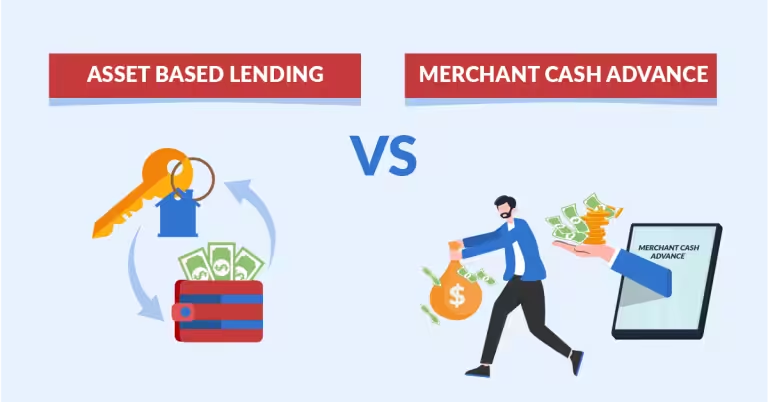
Asset-based lending uses your business assets, such as accounts receivable, inventory, or equipment, as collateral to secure a loan or line of credit. Rates are often lower than MCA costs because the lender's risk is backed by tangible assets. The trade-off is that you need assets to pledge and the approval process usually takes longer. If your business has strong receivables or valuable equipment, asset-based lending often costs less than an MCA. See our detailed comparison of asset-based lending vs. merchant cash advance.
MCA vs. Business Line of Credit
A business line of credit gives you access to a revolving pool of capital that you draw from as needed and pay for only when you use it. It is usually more flexible than an MCA, less expensive in many scenarios, and does not require daily remittance. The catch is qualification: stronger credit, more time in business, and more documentation are often required. If you can qualify for a line of credit, it is often the better option for ongoing cash flow needs.
When an MCA Makes Sense
MCAs fill a gap for businesses that cannot access traditional products. If you have been in business for less than a year, have credit issues, need funding quickly, and have consistent daily revenue, an MCA may be one of the more viable short-term options available. The key is going in with eyes open about the cost and with a clear plan for how the funds will generate enough return to justify that cost.
Managing Multiple Merchant Cash Advances
Stacking MCAs is one of the most dangerous patterns in small business financing. It often happens gradually: the first advance solves a cash flow problem, but the daily holdback creates a new one. A second advance covers the gap, but now two providers may be taking a combined 25% to 35% of daily revenue. A third advance enters the picture, and the business is generating revenue primarily to service its advances rather than fund operations.
Warning Signs of an MCA Debt Spiral
You're taking a new advance primarily to cover payments on an existing one
Your combined holdback percentage exceeds 25% of daily revenue
You can't cover operating expenses without the advance proceeds
Multiple UCC filings are limiting your access to other financing
When Consolidation Makes Sense
MCA consolidation involves replacing multiple active advances with a single lower-cost product, ideally a term loan or line of credit with a fixed payment schedule. Consolidation works best when your business has improved its financial position since taking the original advances: higher revenue, better credit, or more operating history. If you're caught in a stacking cycle, consolidation may be the exit ramp. Read our full guide on merchant cash advance consolidation to understand the process, qualification requirements, and realistic timelines.
Choosing an MCA Provider
Not all MCA providers operate the same way. Factor rates, contract terms, and business practices vary widely across the industry. Before committing to any provider, check these factors:
Factor rate transparency. A reputable provider will disclose the factor rate, total repayment amount, and holdback percentage upfront, in writing, before you sign anything.
Contract terms. Read the agreement carefully. Look for confession of judgment clauses, personal guarantees, early payoff terms, and what happens if your revenue drops significantly.
UCC filing practices. Understand whether the provider files a blanket lien or a specific lien. Blanket liens can block access to other financing.
Funding speed and process. Some providers can fund within one to three business days. If a provider is pushing you to sign faster than you can read the contract, slow down.
Reputation and reviews. Check Better Business Bureau ratings, Trustpilot reviews, and industry forums. The MCA industry includes both reputable providers and predatory ones.
For a curated overview of providers currently operating in this space, see our list of merchant cash advance companies.
Frequently Asked Questions
How does a merchant cash advance work?
An MCA provider purchases a portion of your future revenue at a discount. You receive a lump sum, and the provider collects repayment by withholding a fixed percentage of your daily or weekly sales. Repayment continues until the total agreed amount, determined by the factor rate, is paid back. Because payments are tied to revenue, repayment timing can vary.
What is a factor rate and how does it differ from an interest rate?
A factor rate is a decimal multiplier, such as 1.2 or 1.4, applied to your advance amount to determine total repayment. Unlike an interest rate, which accrues over time, a factor rate sets the total cost upfront. A $50,000 advance at a 1.3 factor rate results in $65,000 in total repayment regardless of repayment speed. This can make MCAs more expensive than they first appear, especially on shorter repayment timelines.
Can I get a merchant cash advance with bad credit?
Yes. MCA providers often evaluate approval based more on business revenue and bank statements than on personal credit scores. Many providers look for several months of consistent revenue and a minimum deposit threshold. Bad credit, limited credit history, or even a prior bankruptcy does not automatically disqualify you. Read more in our guide on merchant cash advances for bad credit.
What are the risks of stacking multiple MCAs?
Stacking means taking multiple merchant cash advances at the same time. Each advance adds another daily holdback from your revenue, which can quickly consume a large share of daily sales. The compounding cost of capital, combined with reduced operating cash flow, can lead to a debt spiral where new advances are taken to support existing ones. If you're already managing multiple advances, consider MCA consolidation as a potential exit strategy.
How does an MCA compare to a business loan?
A business loan typically has an interest rate, a set repayment schedule, and loan-law disclosures. An MCA uses a factor rate, collects repayment as a percentage of revenue, and is usually structured as a purchase agreement rather than a loan. MCAs are often faster to obtain and easier to qualify for, but they usually cost significantly more. A typical MCA with a 1.3 factor rate repaid over about six months can have an APR-equivalent cost above 60%, compared with the lower rates many qualified borrowers can get on traditional small business loans.
Can I consolidate multiple merchant cash advances?
Yes, if your business qualifies. MCA consolidation replaces multiple active advances with a single financing product, ideally at a lower cost. To qualify, you typically need to show improved revenue, several months of payment history, and a viable path to repayment under the new terms. Not every business in an MCA stacking situation will qualify for consolidation, but it is worth exploring. Our MCA consolidation guide covers the process in detail.
Next Steps
Merchant cash advances can serve a purpose, but they are not the right fit for every situation. The businesses that benefit most are those that use MCAs deliberately: for a specific short-term need with a clear revenue payoff, not as a recurring source of working capital.
If you're still weighing your options, learn more about how merchant cash advances work or explore whether a different financing product better fits your needs. When you're ready to move forward, apply for financing through Reil Capital and we'll help you evaluate the right solution for your business.