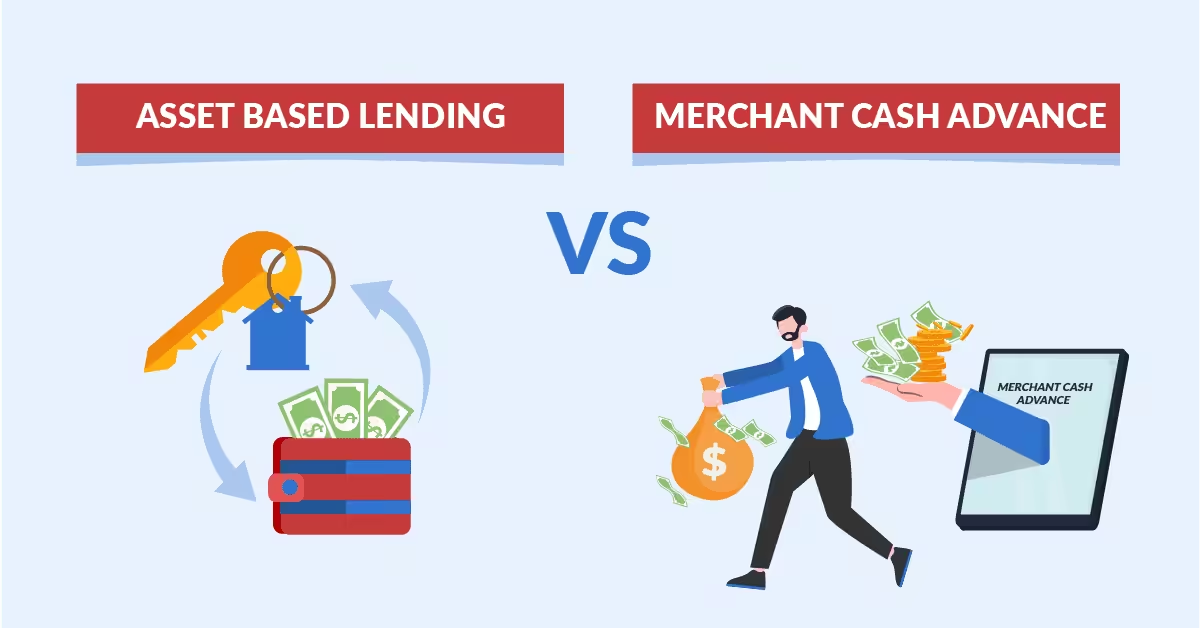
Asset-based lending is a loan secured by your business assets — accounts receivable, inventory, or equipment — while a merchant cash advance is a purchase of your future receivables, not a loan at all. That single structural difference drives everything else: asset-based lending (ABL) is typically cheaper and slower and needs qualifying collateral, while a merchant cash advance (MCA) is faster and requires no specific asset pledge but is far more expensive. The comparison below lines the two up across cost, speed, collateral, qualification, and best fit.
Asset-based lending vs merchant cash advance: side-by-side comparison
The fastest way to see the difference is a direct comparison. ABL is secured, lower-cost, and slower; an MCA is unsecured against future sales, faster, and priced by a factor rate that converts to a much higher effective cost.
| Factor | Asset-Based Lending (ABL) | Merchant Cash Advance (MCA) |
|---|---|---|
| Structure | A loan or revolving line of credit secured by your assets | A purchase of your future receivables — not a loan |
| Cost | Lower; secured pricing, broadly in line with term loans and lines of credit (~14%–99% APR band) | Far higher; a 1.1–1.5 factor rate that converts to an effective APR often in the triple digits, up to ~350% |
| Speed | Slower; collateral valuation and underwriting take time | Fast; same-day is possible, 1–3 business days is typical |
| Collateral | Required — accounts receivable, inventory, equipment, or real estate | No specific asset pledged; advanced against future card and bank-deposit revenue |
| Qualification | Qualifying assets plus supporting financials | Revenue-first; roughly $10,000–$15,000 in monthly deposits, credit scores as low as ~500–550 (some providers set no stated minimum) |
| Repayment | Revolving or term; interest accrues over time and stops when you repay | Fixed payback via daily or weekly ACH, or a ~10%–20% holdback of card sales; no savings for repaying early |
| Best fit | Asset-rich businesses wanting lower-cost, flexible capital | Businesses with steady card or bank revenue that need cash fast and lack collateral |
What is asset-based lending?
Asset-based lending is financing you secure by pledging business assets as collateral — most commonly accounts receivable, inventory, equipment, or real estate. Because the lender’s risk is backed by something tangible, ABL usually prices well below unsecured options and often takes the form of a revolving line of credit you can draw on as needs change. The trade-off is process: the lender has to value and monitor the collateral, so approval and funding are slower than an MCA, and businesses without qualifying assets may not qualify at all. A business line of credit is a close cousin — flexible, revolving, and far cheaper than a merchant cash advance for businesses that can qualify.
What is a merchant cash advance?
A merchant cash advance is not a loan — it is the sale of a portion of your future receivables in exchange for a lump sum today. The Federal Reserve describes the product as one repaid “as a percentage of sales or revenue rather than in fixed payment amounts,” priced by a factor rate instead of an interest rate. In practice a provider advances funds and then collects through a daily or weekly ACH debit, or a fixed holdback (commonly 10%–20%) of your card sales, until the agreed payback is met. Terms are short — usually about 3 to 18 months — and underwriting keys off your bank-statement cash flow rather than a full credit-and-collateral review, which is why an MCA can fund in days. For the full mechanics, see our guide to what a merchant cash advance is.
Cost: the difference that matters most
Cost is where ABL and an MCA separate most sharply, and the factor rate is easy to misread. An MCA factor rate of 1.1–1.5 means you repay $1.10 to $1.50 for every $1.00 advanced — a flat factor rate, not an interest rate, so the cost does not shrink if you repay early. That small-looking multiplier converts to a steep effective APR: the Federal Reserve documented a lender advertising a “factor rate of 1.15” that amounted to an undisclosed estimated APR of roughly 70 percent, and once fees are included MCA APRs can reach the triple digits — up to about 350%. By comparison, online term loans and business lines of credit typically carry APRs of about 14% to 99%, which is why the Fed’s data shows merchant cash advances rank among the most expensive forms of business financing. Asset-based facilities, being secured, generally sit at the lower-cost end alongside those lines of credit — well below a typical MCA.
Speed, collateral, and qualification compared
If speed is the deciding factor, the MCA wins; on cost and flexibility, ABL wins. An MCA can fund same-day, with 1–3 business days the realistic norm after approval, because the provider underwrites on cash-flow history rather than appraising collateral. That same underwriting means an MCA is revenue-first: providers commonly work from about $10,000–$15,000 in average monthly deposits, accept credit scores as low as ~500–550 (some set no stated minimum), and ask for three to six months of bank statements. This does not mean your credit is ignored — the floors are simply low, and revenue consistency, not your FICO score, carries the decision. Asset-based lending flips the equation: it rewards businesses that hold qualifying accounts receivable, inventory, or equipment with lower cost and a revolving structure, but the collateral valuation and monitoring make it slower to close.
The honest trade-offs of each
Neither product is universally “better” — each carries real downsides worth naming before you sign. The honest picture is what should drive the decision.
Where an MCA hurts:
- High effective cost. The factor rate hides a triple-digit effective APR, and because the payback is a fixed dollar amount, there is no interest saving for repaying early.
- Daily or weekly cash-flow drain. Remittances pull from your deposits continuously, which can tighten payroll and inventory spending during slow weeks.
- Stacking risk. Taking a second or third advance while one is still outstanding can push combined remittances to roughly 15%–30%+ of daily revenue, turning short-term relief into a cash-flow spiral.
- Not refinanceable as debt. Because an MCA is a purchase of receivables and not a loan, it cannot be refinanced inside an SBA 7(a) transaction, which limits your exit options if the cost becomes unmanageable.
Where ABL falls short:
- You need qualifying assets. No accounts receivable, inventory, or equipment of sufficient value means no facility.
- Slower to fund. Collateral valuation and ongoing monitoring add time and paperwork an MCA skips.
- Ongoing oversight. Lenders may require regular reporting on the pledged assets, which adds administrative work.
Federal Reserve survey data underlines the cost point: 60% of firms that borrowed from online lenders — the channel most MCAs originate through — reported higher-than-expected costs, a larger share than for any other lender type.
How REIL Capital helps you choose
REIL Capital’s job is to match your revenue, assets, and timeline to the lowest-cost option you actually qualify for — not to push the fastest or most expensive one. Our seven financing products span $5,000 to $10,000,000, including asset-backed facilities like equipment and invoice financing, business lines of credit, and merchant cash advances, so the comparison above becomes a real choice rather than a default. If you are already carrying one or more advances, our merchant cash advance consolidation options can ease the daily remittance pressure — and we will be honest about what each structure does and does not solve. To start, fill out our commitment-free application and a financing specialist will help you weigh ABL, a line of credit, and an MCA against your numbers.
What is the difference between ABL and MCA?
Asset-based lending is a loan or credit line secured by your business assets — accounts receivable, inventory, or equipment — so it prices lower but underwrites slower. A merchant cash advance is a purchase of your future receivables, not a loan, so it funds in days but carries a factor rate that converts to a far higher effective APR. In short: ABL trades speed for lower cost, while an MCA trades cost for speed.
Is a merchant cash advance asset based?
No. A merchant cash advance is not asset-based lending — it is a purchase of your future sales receivables, not a loan secured by a lien on inventory, equipment, or real estate. Because it is a receivables purchase rather than debt, an MCA also cannot be refinanced inside an SBA 7(a) loan.
Is ABL or an MCA better for a small business?
It depends on what your business holds and how fast it needs cash: asset-based lending is usually the better value if you have qualifying collateral and can wait through underwriting. A merchant cash advance fits businesses with steady card or bank-deposit revenue that need funding within days and lack collateral — but it is one of the most expensive forms of financing. If cost is the priority, a business line of credit or an asset-based facility almost always beats an MCA.
Asset-based lending vs merchant cash advance: which is more expensive?
A merchant cash advance is almost always more expensive. Its factor rate of 1.1–1.5 looks small but converts to an effective APR that often reaches the triple digits — the Federal Reserve documented one 1.15 factor rate that equaled roughly a 70% APR. Asset-based facilities and lines of credit typically price in the ~14%–99% APR range, well below a typical MCA.