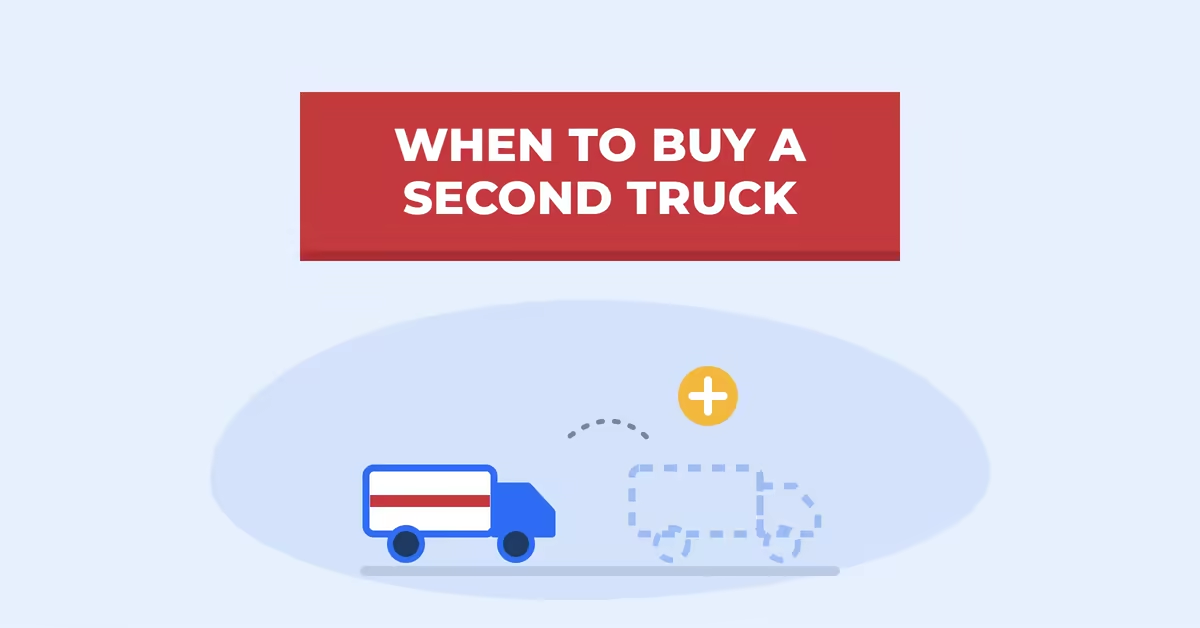
Add a second truck when demand is proven, not hoped-for — you’re consistently turning down steady loads on a lane you can count on and you have a driver ready. The sticker price is the easy part; the insurance jump and the weeks of freight-payment lag before the truck earns are what catch owner-operators short. This guide covers the utilization signals that say go, the true all-in cost beyond the purchase price, how freight seasonality should time the buy, and where equipment financing fits.
Weighing this as one piece of a bigger expansion? See Top Funding Sources for Scaling Up for how each growth move maps to the right funding.
Start With the Demand Signals, Not the Truck
A second truck only makes money if it stays loaded, so pressure-test three signals before you price anything. First, are you consistently turning down loads — week after week, not in one seasonal spike? Second, is that demand tied to a steady lane or a recurring customer, so the truck runs predictable freight rather than whatever the spot market offers that day? Third, do you have a driver lined up? A truck without a qualified, retained driver is a payment with no revenue. If all three hold, capacity is your real constraint and adding a truck is a genuine growth move. If any one is shaky, you’re buying risk, not revenue. For the fuller scaling plan this decision sits inside, see How to Grow a Trucking Company.
The True Cost of a Second Truck
The purchase price is only the first line item. A used, well-maintained Class 8 tractor (3–10 years old) runs $40,000–$90,000; a new Class 8 runs $150,000–$220,000. Two costs beyond the sticker are what actually strain cash flow.
| Cost line | Used Class 8 (3–10 yr) | New Class 8 |
|---|---|---|
| Purchase price | $40,000–$90,000 | $150,000–$220,000 |
| Down payment (10–20%) | ~$4,000–$18,000 | ~$15,000–$44,000 |
| Sample monthly payment | ~$1,700–$1,900 (48-mo term) | $1,600–$4,200+ |
The Insurance Jump
If the second truck comes with a new operating authority, insurance is the ambush. A new CDL authority pays 30–50% more than an established carrier — roughly $900–$1,600 per month in 2026 — because there’s no safety history to price against. That premium hits before the truck turns a wheel, and it’s the line item owner-operators most often leave out of the math.
The Payment Lag Before It Earns
Even fully loaded, a second truck doesn’t pay for itself on day one. You cover fuel, the driver, insurance, and the financing payment weeks before the freight invoices get paid. The median small business holds only about 27 days of cash buffer — roughly four weeks of runway — and a second truck stretches that thinner, because you fund its operating costs ahead of the revenue it produces. Before you buy, make sure your reserve can absorb the gap between the truck going into service and its first checks clearing.
Time the Buy to Your Demand Cycle, Not the Market’s Trough
Freight is seasonal. Volumes peak in Q4 — firming around Labor Day and running through the November–December holiday push — while Q1 (January–February) is the demand trough, with the lowest spot rates of the year. The temptation is to buy in the slow season when a truck looks affordable, but a truck acquired into a trough sits burning insurance and payments with little freight to haul. Time the purchase so the truck comes into service as your own demand ramps — against your booked lanes and recurring customers, not the broader market’s cheapest month.
Financing a Second Truck
Because the truck is a hard asset, equipment financing uses it as collateral — which typically means a smaller down payment and a lower rate than an unsecured loan, and it keeps any line of credit free for fuel, payroll, and the working-capital gap. Most equipment financing covers 80–100% of the cost over 24–84 months, with 10–20% down common on trucks; the rate moves with your credit profile. On a $70,000 used truck financed over 48 months, payments commonly land around $1,700–$1,900 a month. Match the term to how long you’ll keep the truck earning, not just to the lowest possible payment.
When NOT to Buy a Second Truck
Hold off if the demand is a spike, not a trend — chasing a spot-rate surge with a multi-year payment is how one good month becomes a two-year liability. Hold off if a single shipper drives most of your freight, because losing that contract leaves both trucks under-fed. And hold off if your cash reserve can’t cover the insurance jump plus several weeks of operating costs before the truck earns. A second truck accelerates a proven operation; it deepens the hole under a thin or shaky one. The goal is to add capacity you could almost keep busy today.
Put Your Second Truck to Work
REIL Capital matches owner-operators to equipment financing built for the asset — the truck secures the loan, so more of your cash stays free for fuel, insurance, and the payment-lag gap. Apply now to see what your business qualifies for.
Frequently Asked Questions
- When should I buy a second truck for my trucking business?
When capacity is your real constraint: you’re consistently turning down loads on a steady lane or for a recurring customer, and you have a qualified driver lined up. If the demand is a seasonal spike or rests on one shipper, wait — the truck’s payment and insurance run whether or not it’s loaded. - How much does a second semi truck cost?
A used, well-maintained Class 8 tractor (3–10 years old) typically runs $40,000–$90,000, and a new Class 8 runs $150,000–$220,000. Budget beyond the sticker for the insurance jump and several weeks of operating costs before the truck’s freight invoices get paid. - What is the true cost of adding a truck to my fleet?
Three layers: the truck itself, the insurance (a new authority pays 30–50% more — roughly $900–$1,600 per month), and the freight-payment lag, where you cover fuel, the driver, and the payment weeks before invoices pay out. With the median small business holding about 27 days of cash buffer, that lag is what catches owner-operators short. - Should I buy a used or new truck as my second truck?
A used Class 8 costs far less up front ($40,000–$90,000 vs. $150,000–$220,000) and carries a smaller payment, but weigh that against maintenance and downtime risk. New trucks cost more each month ($1,600–$4,200+) but offer warranty coverage and predictable uptime. Match the choice to how hard and how long you’ll run the truck. - How do I finance a second truck?
Equipment financing is the common route: the truck serves as collateral, so it usually needs a smaller down payment (10–20%) and a lower rate than an unsecured loan, with terms of 24–84 months. On a $70,000 used truck over 48 months, payments commonly run around $1,700–$1,900 a month, depending on credit.
Timing a big purchase around the industry’s seasonal cash-flow dips? Our trucking cash-flow calendar maps out the Q1 trough.